The scheme seeks to provide cost efficient, broad large-cap exposure with an implementation approach
designed to manage trading and impact costs while keeping portfolio positioning close to the scheme’s
benchmark over time, using the efficient instruments and maintaining a small active share
- Broad Diversification: Exposure to India's top 100 large-cap companies provides broad
market coverage.
- Costs Efficiency: Efficient management of fund execution costs may allow a larger share
of your returns to stay invested with you
- Low Active Share: Portfolio positioning that seeks to stay close to the benchmark, aiming
to reduce stock-selection risk.
- Smart Execution: Investment strategies aimed at managing execution costs and supporting
net returns.
The scheme may deploy the below strategies to get exposure in a cost-efficient manner:
- Single‑stock futures at a discount: When a stock’s near‑month futures trade below the
cash (spot) price, we may use such futures aiming to obtain exposure more efficiently (subject to
limits and regulations).
- Index futures at a discount: Similarly, if index futures trade below index levels, we may
use such futures to obtain exposure efficiently.
- Merger‑related arbitrage: When a Company in an Index is merging with another firm, the
scheme may buy the stock which is at a discount to the announced merger ratio up to permissible
limits.
- Smarter rebalancing: When the Nifty 100 constituents' change, we may rebalance gradually
rather than on the exact index date to seek better execution.
- Small opportunistic active share: Around corporate actions (demergers/special
situations), we may phase entries/exits to manage liquidity and impact costs. The aim is to keep
overall active share low (<10%).
We seek exposure to the Nifty 100 TRI constituents in terms of market capitalization, we do not
BUY/SELL stocks based on their Valuation or Fundamentals.
| Particulars |
Typical Large Cap Mutual Funds |
Parag Parikh Large Cap Fund |
| Using Valuations and Fundamentals for Stock Selection |
Yes |
No |
| Active Share |
Generally Higher |
Lower |
| Expense Ratio |
Typically Higher |
Lower |
| Portfolio Turnover |
Typically Higher |
Typically Lower |
| Performance versus the Index |
May diverge significantly from the benchmark index |
Aims to keep portfolio positioning close to the scheme's benchmark |
The Scheme will employ rules-driven stock selection of the Nifty 100 index stocks that covers top 100
companies in India based on free float market capitalization. The weight of any holding will be capped
at 10%.
To understand whether this scheme is suitable for you or not, you must understand your investment
objective, risk appetite and the investment horizon you are comfortable with.
This scheme is ideal for investors who:
- Seek broad exposure to India’s top 100 companies by Market Capitalization
- Prefer lower costs compared to typical active funds
- Value a strategy that aims to deliver index-like returns
- Have a long-term investment horizon (5+ years)
- Understand that equity investments can be volatile
- Value tactical efficiency in implementation
This scheme may NOT be suitable for investors who:
- Seek to significantly outperform the index
- Prefer concentrated bets on specific stocks or sectors
- Prefer active stock selection based on fundamentals
- Have a short-term investment horizon
- Cannot tolerate equity market volatility
- • Expect the scheme to avoid overvalued stocks
Investors are advised to consult their financial advisor for any investment decisions.
The Scheme offers two Plans:
- Direct Plan
- Regular Plan
Both Regular and Direct Plan(s) offers two Options, viz.,
- Growth Option
- Income Distribution cum Withdrawal (IDCW) Option.
Sub-options under IDCW:
- Payout of IDCW
- Re-investment of IDCW
Since PPLCF will invest at least 65% of its corpus in Indian equities and equity-related instruments,
it will be taxed as an Equity-Oriented Fund. Here is how the scheme will be taxed:
|
Tax Implications of Investing in PPLCF (an Equity Oriented Fund)
|
| Tax Status of Investor |
Capital Gains Tax |
Tax on Distributed Income under IDCW Option |
TDS on Capital Gains |
TDS on Distributed Income IDCW Option |
| Short Term |
Long Term* |
| Resident Individual/HUF/AOP/BOI |
20% |
12.50% |
At the applicable Tax slab rate |
NIL |
10%** |
| Domestic Companies |
20% |
12.50% |
At the applicable Tax slab rate |
NIL |
10%** |
| N R I s |
20% |
12.50% |
At the applicable Tax slab rate |
STCG – 20%
LTCG – 12.5% |
20% |
*LTCG is exempt up to 1.25 lacs in each financial year for equity oriented funds.
**TDS will be applicable in case of dividend payment exceeding Rs. 10,000.
All taxes shall be increased by applicable surcharge and health & education cess.
For Detailed information on Tax Rates for Mutual Fund Investors and Other Tax Provisions, please read
the complete text by AMFI here,
Tax
Regime for Mutual Funds, or refer our
Tax
Reckoner.
Minimum Application Amount –
- Lumpsum:
| New Purchase |
Rs. 1,000/- and in multiples of Re. 1 thereafter. |
| Additional Purchase |
Rs. 1,000/- and multiples of Re. 1 thereafter. |
- SIP:
| Monthly SIP |
Rs. 1,000/- and in multiples of Re. 1 thereafter |
| Quarterly SIP |
Rs. 3,000/- and in multiple of Re. 1 thereafter. |
- Minimum unit holder's account balance or minimum amount of application at the time of STP
enrolment in the Transferor Scheme should be Rs.6000/-
- Minimum unit holder's account balance or minimum amount of application at the time of SWP
enrolment in the Transferor Scheme should be Rs.12000/-
| Investment Objective |
The objective of the Scheme is to generate long term capital appreciation and income distribution
to investors by predominantly investing in equity and equity related instruments of large cap
companies. However, there is no assurance that the investment objective of the Scheme will be
achieved and the Scheme does not assure or guarantee any returns. |
| Load Structure |
Exit Load: Nil
Entry Load: Not Applicable
|
| Category of the Scheme |
Large Cap Fund |
| AMFI Tier I Benchmark Index |
NIFTY 100 TRI |
| Asset Allocation Pattern |
Equities & Equity related securities of large cap companies: 80% - 100%. (Risk Profile - Very
High)
Equities & Equity related securities of other than large cap companies, equity & equity related
securities of foreign companies: 0% - 20%. (Risk Profile - Very High)
Debt and Money Market Instruments: 0% - 20% (Risk Profile - Low)
Units issued by REITs and InvITs: 0% - 10% (Risk Profile - Low to Medium)
|
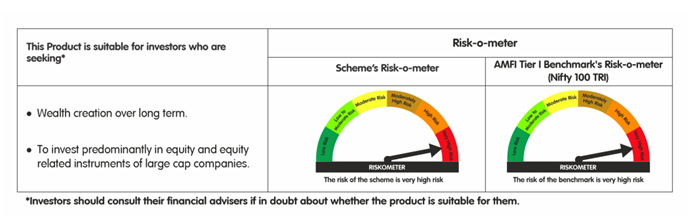
Risk-o-meter is as on: December 31, 2025 | Category of Scheme: Large Cap Fund
Large Cap Company means 1st-100th company in terms of full market capitalisation.
Disclaimer - The information provided in here is for illustrative and informational purposes only
and does not constitute an offer, solicitation, or recommendation to invest in the scheme mentioned herein.
The fund’s investment objective, asset allocation, and risk profile are as described in the scheme offer
documents, and investor are advised to read them carefully before investing. All information has been
obtained from sources believed to be reliable; however, no guarantee, warranty, or representation is made
regarding its accuracy, completeness, or adequacy. Investors should consult their financial and/or tax
advisors prior to investing. Tax laws are subject to change.
